

Treat your 2027 entry-level hires as their own budget line and not part of overall headcount. The best current payroll data shows that employment in AI-exposed jobs is shifting, with fewer junior hires rather than layoffs. Most marketing budget discussions are looking somewhere else.
In July, I argued that chief marketing officers should fund five functions instead of legacy channel buckets. In September, I argued that SEO and paid media managers become directors by proving AI pays for itself while keeping their teams intact. Stanford’s Erik Brynjolfsson, Bharat Chandar, and Ruyu Chen, and Kevin Indig’s October planning memo, support parts of both arguments.
They also expose a gap.
What Stanford Measured, And What It Can’t Tell You
The Stanford Digital Economy Lab working paper, revised Aug. 12, 2026, draws on anonymized ADP payroll records. The analysis sample is a balanced panel of firms with between 3.5 and 5 million employees per month, running through June 2026.
The headline finding is that employment of workers aged 22 to 25 in AI-exposed occupations stands 19% below where it would be if it had kept pace with their less-exposed peers. In raw terms, the two most exposed quintiles of young workers fell about 11% since November 2022, while the three least-exposed quintiles grew about 10%.
Experienced workers show no comparable gap. Every older age group grew over the same period, by as much as 11% for workers aged 35 to 40.
The mechanism matters more than the headline. The authors say the divergence works mainly through reduced hiring of young workers, and separations among young workers fell at least as much in the most exposed occupations as in the least exposed. That is the opposite of what displacement would imply. The declines concentrate where AI substitutes for human tasks. Where AI complements workers, employment is flat or rising, especially for experienced workers, and the adjustment shows up in employment, not in pay.
The authors of the Stanford paper call the facts “early, descriptive indicators,” and say the work does not estimate a causal impact of AI. The pattern shrinks when they control for education, from about -0.18 to -0.09 in their primary sample, and the smaller figure is significant only at the 10% level. Earlier versions of the paper reported regression estimates of 13% and 16%, and the headline measure has since changed, so the 19% should not be lined up against those numbers.
The paper also measures occupations broadly. It reports no SEO or marketing figures.
My July Column Holds Up, With 1 Missing Line
In my previous article, 2027 Marketing Budgets, I told CMOs to rebuild the budget around five functions, one of them human judgment and editorial oversight. I also cited Gartner data showing labor rising from a mean 21.9% to 24.5% of marketing budgets, even though 43% of CMOs expected to cut labor spending.
Stanford’s paper supports the editorial oversight budget line. Where AI complements workers, employment holds or grows, especially for experienced workers. That describes the editors and strategists I argued CMOs should be able to defend.
What the column did not say is who that labor money pays for. My view is that the extra labor share is going to experienced people, while the seats that would have gone to 22- to 25-year-olds in exposed jobs are quietly left empty. Gartner doesn’t split marketing labor by seniority, and Stanford doesn’t break out marketing, so I can’t prove it. But a budget that raises labor share while freezing entry-level hiring has not told the CFO what it is funding, and I think that omission will be the first thing a sharp finance chief finds.
See also: How To Restructure Your Marketing Team & Budget For The AI-Search Era
My September Column Needs A Sharper Test
In my other article about how an SEO or paid manager can become a director, I said the managers most likely to move up are the ones who can prove AI pays for itself while keeping their teams intact.
The Stanford paper finds the adjustment happens through hiring and not through layoffs. A team can be fully intact on the day a manager presents the scorecard and still be shrinking, because the junior seat that would have been filled this year never was. “Intact” tells you who is still there. It says nothing about who was NOT hired.
If the entry-level pipeline narrows, the pool for the next generation of managers narrows with it. That is my inference, not something the paper tests, and it is the part of this story I would watch most closely.
One more reconciliation. The Harvard Business School study I cited in September looked at job postings through March 2025, so it is a demand signal. Stanford measures realized employment through June 2026. They point the same direction, but I would not add the 13% and the 19% together.
Kevin Indig Gives The Gap Somewhere To Land
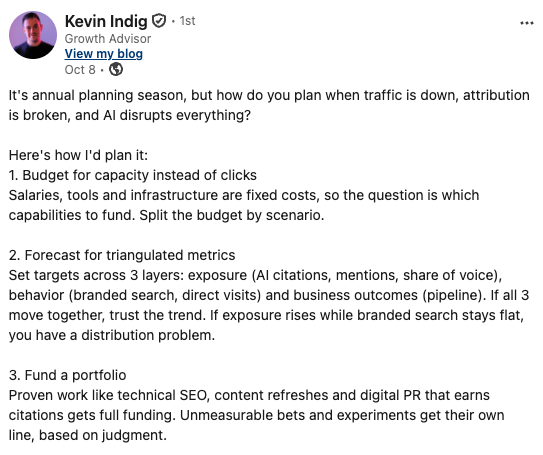
Kevin Indig’s Growth Memo on planning 2027, summarized in a LinkedIn post, starts from a premise I share. Salaries, tools, and infrastructure are fixed costs, so the real budget question is which capabilities to fund. Proven work such as technical SEO, content refreshes, and digital PR that earns citations gets full funding, while unmeasurable bets get their own line based on judgment.
The memo goes further than the post. It adds a capped bucket for learning work, with one owner and a decision date, and argues that community work needs a named owner and fixed weekly hours or it gets cut first. It suggests roughly 5% of the marketing budget for community, sometimes 10%.
His three measurement layers also fill a hole in my September scorecard, which tracked hours saved, hours returned, outcomes, and cost. Kevin says to set targets for “exposure (AI citations, mentions, share of voice), behavior (branded search, direct visits), and business outcomes (pipeline),” and to read them together. If exposure rises while branded search stays flat, he says, you have a distribution problem.
Put Stanford and Kevin side-by-side and a junior role looks different. The tasks I listed in September as most exposed, recurring reports, bulk title tags, and bid adjustments, are the ones juniors used to learn on. Those are my inferences about SEO, and Stanford did not test them. Community work, digital PR, and tracking where AI engines cite you are the work Kevin says needs an owner and hours, and they are much harder to hand to a model.
My position is that a junior seat built around that work belongs in Kevin’s learning bucket, with a named owner, set hours, and a decision date. That is a stronger case to a CFO than keeping a seat because it has always existed.
See also: Why Digital PR Fundamentals Beat AI Tactics: What Marketing Leaders Should Focus On
How To Use This In Your 2027 Plan
Sort every junior task by what AI does to it. List what your 22- to 25-year-olds actually do each week. Mark each task as one a model can substitute for or one that depends on judgment and relationships. Stanford did not study SEO, so run your own check, even a month of simple time tracking. It repeats the re-tagging step from my July column, only at the task level.
Write the entry-level role into the learning bucket. Give it a named owner, fixed weekly hours for community, off-site mentions and citation tracking, a quarterly review, and a decision date. If the role cannot name its weekly output in those terms, it is a seat you are keeping out of habit.
Put a hiring line on the scorecard. Next to hours saved, hours returned, outcomes, and cost, show the seats you chose not to fill and why. Report Kevin’s three layers monthly beside it. When the CFO asks why labor share is up, you can show what it buys and what it does not.
Where I Land
I went into this exercise confident that my July and September columns were broadly right, and they are. What I got wrong was how little they said about the people who never appear on a headcount report.
My position for 2027 is that an intact team is the wrong approach. A team you are still training is the better measure. If AI pays for itself in your shop, some of the savings should show up as a junior seat with a real job attached. Stanford calls its own data early, and so do I. But a budget approved this fall will help decide who is in the room when the next directors are chosen, and I would rather argue about that now than discover it later.
More Resources:
- The SEO Skills Gap: Why Technical Expertise Alone Won’t Cut It Anymore
- Harvard Found The Public Has Little Objection To AI Taking Search Marketers’ Jobs
- Using AI To Assist With SEO Work, Not Replace The Worker
Featured Image: Anton Vierietin/Shutterstock
